



My Boss Told Me to Clock Out and Keep Working – Is That Legal in New York?
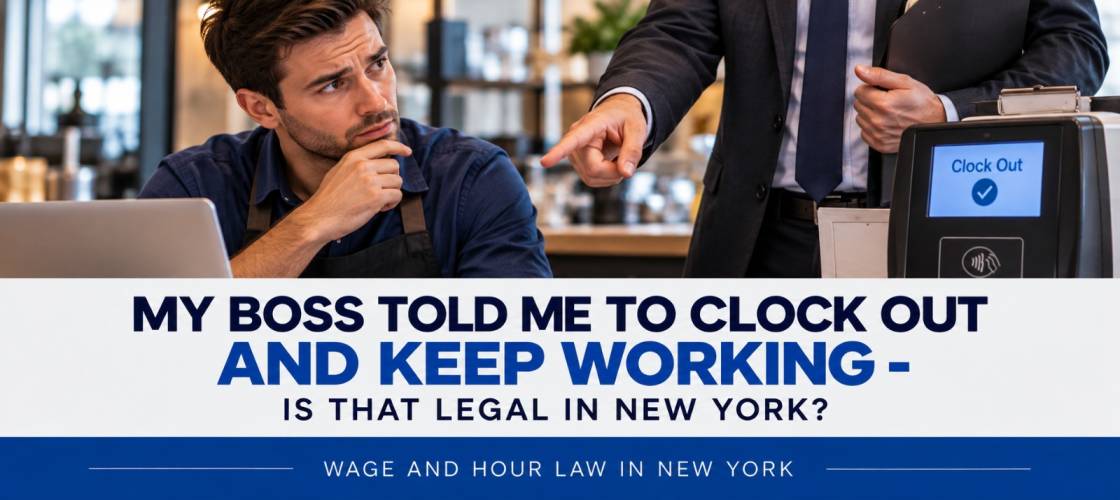
Your Shift Ended. Your Work Didn’t.
Your manager tells you:
“Clock out first, then finish cleaning.”
Or:
“You’re already at 40 hours. Clock out and finish what you need to do.”
Maybe you’re asked to close the store, finish paperwork, answer a few more customer questions, clean equipment, complete a report, or prepare things for the next shift.
You’re technically clocked out but you’re still working.
For many employees, it may seem like just another workplace rule they have to follow.
But if you are a covered, non-exempt employee, work your employer requires or allows you to perform generally counts as working time under federal wage and hour law.
Clocking out does not necessarily mean your compensable workday has ended.
If your employer tells you to clock out and then expects you to continue performing job duties, you may be working “off the clock” and that time may need to be paid.
What Does “Working Off the Clock” Mean?
Working off the clock generally means performing compensable work without that time being counted in your paid working hours.
It can happen before a shift, after a shift, during an unpaid break, or even away from the workplace.
For example:
Your shift ends at 6:00 p.m.
Your manager tells you to clock out at 6:00.
But then you’re expected to spend another 20 minutes cleaning, closing registers, finishing paperwork, or helping customers.
Your timecard says:
Clock out: 6:00 p.m.
But you actually stopped working at:
6:20 p.m.
Those 20 minutes may matter.
The fact that the timeclock says your shift ended does not necessarily determine when your compensable work actually ended.
Can Your Boss Tell You to Clock Out and Keep Working?
An employer can tell an employee when a scheduled shift ends.
An employer can also establish workplace policies concerning overtime and when employees are permitted to work.
But that does not necessarily mean an employer can require or allow a covered employee to perform compensable work and simply exclude that time from payroll.
Under the Fair Labor Standards Act, work that an employer “suffers or permits” an employee to perform generally counts as hours worked.
In practical terms, if an employer knows or has reason to know that an employee is continuing to perform work, that time may be compensable even when the employer did not formally request the extra work.
This is particularly important when a manager directly tells an employee:
“Clock out and finish this.”
In that situation, the employer may have direct knowledge that work is continuing after the employee has clocked out.
“But It Was Only 10 Minutes”
A manager might say:
“It’s only a few minutes.”
But small amounts of unpaid working time can become significant when they happen repeatedly.
Imagine you are required to work an additional 15 minutes after clocking out.
Five days per week:
15 minutes × 5 = 75 minutes
That’s:
1 hour and 15 minutes per week.
Over 50 working weeks:
62.5 hours.
Now imagine you regularly work 30 minutes after clocking out.
That could become:
2.5 hours per week
or approximately:
125 hours over 50 weeks.
Whether particular time is legally compensable depends on the circumstances, but employees should not automatically assume that repeated unpaid work does not matter simply because each individual occurrence seems short.
Common Examples of Working After Clocking Out
Off the clock work can happen in almost any industry.
Here are some situations workers may recognize.
Retail Employees
A store closes at 9:00 p.m.
Employees are instructed to clock out at 9:00, but then must:
· clean the store;
· count merchandise;
· organize shelves;
· return items;
· close registers;
· prepare deposits;
· lock up; or
· complete closing checklists.
If those are required job duties, the time spent performing them may be compensable.
Restaurant Workers
A server, bartender, cook, dishwasher, or other restaurant employee clocks out but is expected to continue:
· cleaning;
· rolling silverware;
· preparing the restaurant for the next day;
· restocking;
· completing side work;
· closing the kitchen; or
· helping remaining customers.
The employee may be off the clock, but they may still be working.
Office Employees
Off the clock work is not limited to physical jobs.
An employee may clock out or leave the office and then be expected to:
· finish a report;
· enter data;
· answer work emails;
· complete required documentation;
· respond to a manager;
· update customer records; or
· finish an assignment from home.
The location where the work occurs does not necessarily determine whether the time is compensable.
Healthcare Workers
A worker’s scheduled shift ends, but patient related responsibilities may continue.
For example, an employee may need to complete charts, update records, finish required documentation, or handle other duties after the scheduled shift.
If an employer knows that employees are continuing to perform compensable work, simply labeling the additional time “unauthorized” does not necessarily eliminate the obligation to pay for it.
Warehouse and Manufacturing Workers
Employees may be expected to clock out before completing tasks such as:
· cleaning equipment;
· shutting down machinery;
· completing production paperwork;
· returning tools;
· organizing work areas; or
· performing required end of shift duties.
Again, the important question is not simply when the employee punched out.
It is when the compensable work actually stopped.
What If Your Manager Says Overtime Wasn’t Approved?
This is an important distinction.
An employer may have a policy requiring employees to obtain approval before working overtime.
The employer may also enforce workplace rules concerning unauthorized overtime.
But a policy requiring advance authorization does not automatically mean an employer can refuse to pay for compensable work that was actually performed.
For example:
Your manager tells you:
“No overtime is allowed.”
But at 5:00 p.m., the same manager gives you another task that takes 30 minutes to complete.
If the manager knows you are performing the work, the fact that overtime was not “approved” does not necessarily make the time unpaid.
Employers can manage when employees are allowed to work.
What they generally cannot do is knowingly accept the benefit of compensable work while simply excluding the working time from payroll.
What If You Voluntarily Keep Working?
The answer can still depend on what your employer knows.
Suppose your scheduled shift ends at 5:00 p.m., but you voluntarily stay until 5:30 to finish an assigned report.
You never received a direct instruction to stay late.
However, your supervisor regularly sees you working after 5:00 and accepts the completed work.
Federal wage-and-hour principles generally look not only at work specifically requested by an employer but also at work the employer allows an employee to perform.
That means:
“Nobody told you to stay late”
does not necessarily resolve the issue if the employer knew or had reason to know that you were continuing to work.
What If Your Boss Tells You Not to Record the Extra Time?
That should get your attention.
Examples might include:
“Don’t put those extra 20 minutes on your timesheet.”
“You can’t report more than 40 hours.”
“Clock out, then finish closing.”
“Change your timecard to 5:00.”
“Take the overtime off before submitting your hours.”
Employees should preserve records when they receive instructions like these.
A timecard is supposed to help document working time. It should not be treated as a mechanism for excluding compensable work simply because paying for that time would increase payroll costs.
What If Your Employer Changes Your Timecard?
Sometimes an employee accurately records their time, but the final payroll record looks different.
For example:
Employee clocks out: 6:27 p.m.
Later, payroll shows:
5:59 p.m.
There can be legitimate reasons for correcting a timecard for example, when an employee accidentally forgets to clock out.
But if time records are being changed to remove compensable hours actually worked, that may result in unpaid wages.
If you notice changes, preserve copies of the records available to you and compare them with your own notes about when you actually stopped working.
What About Working Before You Clock In?
Off-the-clock work can happen at the beginning of a shift too.
Suppose your employer says:
“Your shift starts at 9:00, so don’t clock in until 9:00.”
But employees are expected to arrive at 8:45 to:
· turn on computers;
· log into required systems;
· prepare equipment;
· open the workplace;
· review assignments;
· set up workstations; or
· complete other required tasks.
The question is not simply what time the schedule says the shift begins.
The issue is when compensable work actually begins.
If employees are required or allowed to perform compensable work before their recorded starting time, those minutes may need to be included in their working hours.
What About Working During an Unpaid Lunch Break?
The same concept can apply to meal periods.
Suppose your employer automatically deducts 30 minutes for lunch.
But during that “unpaid” break, you’re regularly required to:
· answer phones;
· help customers;
· monitor a workstation;
· respond to a supervisor;
· complete paperwork; or
· perform other job duties.
If you are performing compensable work during an automatically deducted unpaid period, your recorded hours may not accurately reflect the time you actually worked.
Can Off-the-Clock Work Affect Overtime?
Yes.
For many covered, non-exempt employees, overtime generally becomes due after more than 40 hours of work in a workweek.
Consider an employee whose payroll record shows:
40 hours
But the employee also performed:
30 minutes of unpaid closing work each day for five days.
That would add another:
2.5 hours
of potentially compensable time.
The employee’s actual working time could therefore be:
42.5 hours
rather than 40.
If the employee is entitled to overtime under applicable law, those additional hours may affect the overtime calculation.
This is one reason off the clock work can be more significant than it initially appears.
How Can You Tell If This Is Happening to You?
Ask yourself:
Do I perform work before I clock in?
Do I continue working after I clock out?
Does my manager ask me to finish tasks after punching out?
Am I expected to work during unpaid meal periods?
Do I receive work assignments after my scheduled shift?
Does my paycheck always show exactly 40 hours even though I regularly work more?
Have I been told not to report extra time?
Have hours disappeared from my timecard?
If you answer yes to one or more of these questions, consider reviewing your records more carefully.
What Records Should You Keep?
If you believe you are working off the clock, documentation can be important.
Consider preserving information you are lawfully permitted to keep, including:
· pay stubs;
· timecards;
· work schedules;
· screenshots of your own time records;
· emails;
· text messages;
· messages from supervisors;
· calendars;
· payroll records available to you; and
· your own contemporaneous notes.
Your personal record can be simple:
Date | Clock-Out Time | Actual Time Work Ended | Work Performed
For example:
Sept. 14 | 6:00 p.m. | 6:24 p.m. | Cleaned workstation and completed closing report
Sept. 15 | 6:00 p.m. | 6:18 p.m. | Helped remaining customers and closed register
Sept. 16 | 6:00 p.m. | 6:27 p.m. | Inventory and closing duties
Over several weeks, a pattern may become easier to identify.
What If You Don’t Have Time Records?
Do not automatically assume that you have no options simply because you did not take screenshots of every timecard.
Other information may help show when you were working.
For example:
· emails sent after your recorded clock-out time;
· messages from supervisors;
· schedules;
· work system activity;
· closing reports;
· customer communications;
· calendars; and
· coworkers who observed workplace practices.
New York employers also have payroll recordkeeping obligations.
The absence of personal timecard copies does not necessarily mean an employee should ignore a potential wage problem.
Can Your Employer Retaliate Because You Ask About Unpaid Wages?
New York Labor Law contains protections against retaliation for certain employee complaints concerning Labor Law violations.
Retaliation can potentially take different forms, depending on the circumstances.
Employees concerned about retaliation should document what happened, when they raised the wage issue, who was involved, and what occurred afterward.
What Can You Do If You Were Not Paid for All Your Work?
Start by documenting the time.
Compare your pay stubs and time records with the hours you actually worked.
Calculate approximately how much off the clock time occurs during a typical week.
Then determine whether the problem happened once or whether it has been occurring repeatedly.
The New York State Department of Labor accepts certain unpaid wage claims when an employer did not pay an employee for all hours worked.
Depending on the circumstances, an employee may also want to speak with an employment attorney about potential unpaid wages, overtime, and other available remedies.
Frequently Asked Questions
Can my boss legally tell me to clock out and keep working?
An employer can determine work schedules and establish timekeeping policies, but requiring or allowing a covered employee to perform compensable work after clocking out may create an obligation to pay for that working time.
What if my manager says I cannot report more than 40 hours?
A workplace policy limiting overtime does not automatically eliminate the right to compensation for compensable hours actually worked. An employer may enforce its work rules, but federal wage-and-hour principles generally require covered employees to be paid for work the employer requires or permits.
Can I be paid if I voluntarily stayed late?
Potentially. Work does not necessarily have to be specifically requested to count as working time. If an employer knows or has reason to believe an employee is continuing to perform work, the time may be compensable.
Does answering work emails after clocking out count as work?
It can, depending on the circumstances. Work performed away from the workplace can still constitute compensable working time. The nature of the activity, frequency, employer knowledge, and other facts can matter.
What if I work only 10 or 15 minutes after clocking out?
Do not assume repeated short periods automatically do not matter. Small amounts of time can accumulate substantially when they occur regularly. Whether particular time is legally compensable depends on the specific circumstances.
What if my employer automatically deducts my lunch?
An automatic deduction does not necessarily resolve whether you performed compensable work during that period. If you regularly work during an unpaid meal period, preserve records showing what occurred.
What if I don’t have proof?
Start preserving what you have now. Pay stubs, schedules, messages, emails, time records, and contemporaneous notes may all provide useful information. Employers also have recordkeeping obligations under applicable wage-and-hour laws.
Can unpaid off-the-clock work result in unpaid overtime?
Potentially. If additional compensable time causes a covered, non exempt employee’s hours to exceed 40 in a workweek, overtime requirements may apply.
Clocked Out Doesn’t Always Mean Your Workday Is Over
Your employer’s timeclock records when you punched out.
It does not necessarily determine when you actually stopped performing compensable work.
If your manager tells you to clock out and then asks you to clean, finish paperwork, close the store, help customers, complete reports, or perform other required duties, those additional minutes can add up.
And if it happens every day, the difference between your recorded hours and your actual working hours can become substantial.
Sanders Law Group represents New York workers in wage-and-hour matters involving unpaid wages, unpaid overtime, off-the-clock work, and other compensation disputes.
If you believe you have been required to work before clocking in, after clocking out, or during unpaid time, contact Sanders Law Group to discuss your situation and learn more about your legal options.