



Sent Home Early After Reporting to Work? Your New York Right to Call In Pay.
Introduction: What Happens When Your Employer Sends You Home Early?
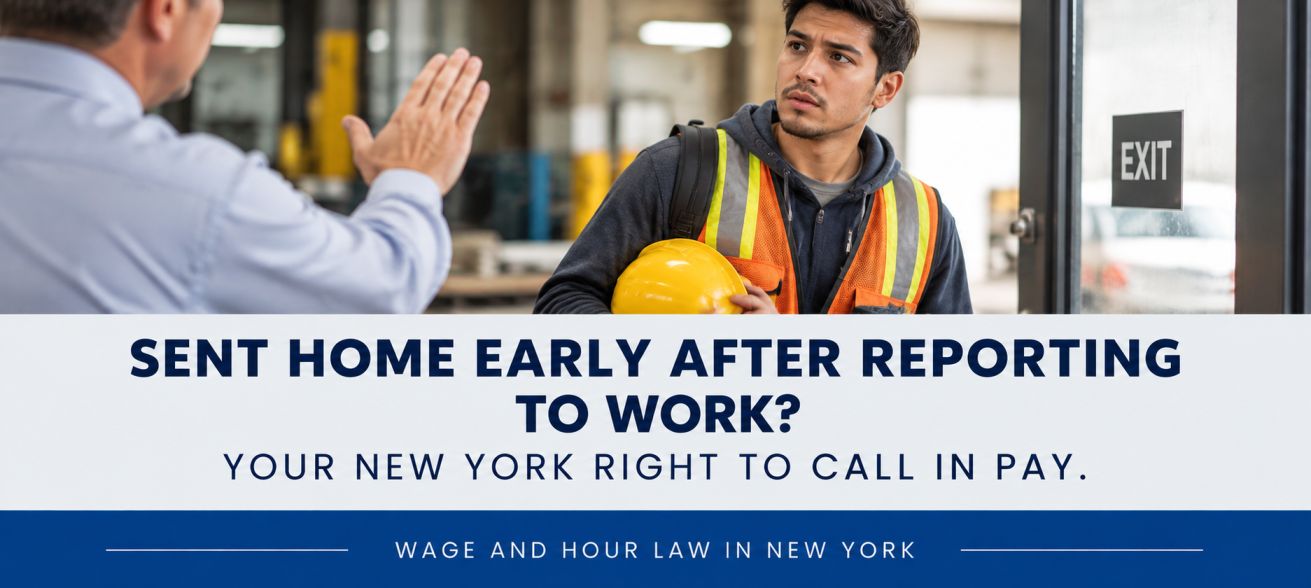
Imagine arriving at work for a scheduled shift, only to be told that business is slow and you are no longer needed. You may have spent time commuting, arranged childcare, or turned down other opportunities to make it to work. Yet, instead of working your expected shift, you leave after only an hour or two.
For New York employees, this situation raises an important question: Can an employer send you home early without paying you for the rest of your scheduled shift?
The answer depends on the applicable wage rules and the circumstances surrounding your shift. New York has call-in pay requirements that may require employers to provide additional pay when employees report to work but receive little or no work.
However, these rules do not automatically guarantee payment for every hour originally scheduled. The applicable industry wage order, the length of the shift, and the time actually worked can all matter.
Understanding these rules can help employees recognize when an early dismissal may raise a wage-and-hour issue.
What Is Call-In Pay Under New York Law?
Call-in pay refers to compensation that may be required when an employee reports for work at an employer’s request or with the employer’s permission but receives less work than expected.
For employees covered by New York’s Miscellaneous Industries and Occupations Wage Order, the call-in pay regulation generally requires payment for at least four hours, or the number of hours in the regularly scheduled shift, whichever is less, at the basic minimum hourly wage.
Other industries may follow different rules. For example, New York’s hospitality wage order uses a different formula for qualifying call-in situations.
Employees should therefore determine which wage order applies to their jobs before calculating the amount that may be owed.
When Might You Qualify for Call-In Pay?
Call-in pay may become relevant in situations such as these:
- You are sent home because business is slow. You arrive as scheduled, but your employer says there is insufficient work.
- Your shift is cut short. You are scheduled to work several hours but are told to leave much earlier.
- You report for work but receive no assignments. Your employer asks you to come in, but little or no work is available.
- Your employer changes staffing needs after you arrive. The business decides that fewer employees are needed after your shift has started.
Whether additional pay is required depends on the wage order covering your employment and the specific facts. Simply having a scheduled shift does not mean every employee is automatically entitled to payment for all scheduled hours.
How Much Call-In Pay Could You Receive?
The calculation depends on the applicable industry rules.
For example, under the general rule for employees covered by the Miscellaneous Industries and Occupations Wage Order, the minimum call-in pay period is four hours or the number of hours in the regularly scheduled shift, whichever is less. Payment for the qualifying period is calculated at the basic minimum hourly wage, subject to the regulation’s terms.
Consider an employee whose regularly scheduled shift is six hours. The employee reports to work but is sent home after one hour because business is slow.
Under the general miscellaneous-industry formula, the four-hour minimum may apply. The employee’s actual attendance must be paid at the applicable rate, and any additional qualifying call-in pay is calculated according to the regulation.
This is an illustration of the rule, not a determination that every worker in this situation qualifies. Hospitality employees and workers in other specially regulated industries may have different calculations.
Does Call-In Pay Apply If You Voluntarily Leave Early?
The reason you leave work can matter.
Call-in pay rules are generally designed to address situations where an employee reports as requested but the employer provides insufficient work or sends the employee home.
If you independently choose to leave early, without being directed or influenced by the employer to do so, you may not qualify for additional call-in pay.
However, a situation may be different if a manager asks you to leave and describes the decision as voluntary. Employees should document what actually happened rather than assuming that the employer’s wording settles the question.
What If Your Employer Cancels Your Shift Before You Arrive?
A shift cancelled before an employee reports to work can raise different issues from a situation in which an employee arrives and is then sent home.
The general call-in pay rules discussed above focus on reporting for work. Other requirements may apply depending on the industry, the employment arrangement, and the amount of notice provided.
Employees in construction should also be aware that New York has enacted separate reporting-pay provisions for certain covered construction projects, with an effective date of December 8, 2026. Those provisions have their own requirements and should not be confused with the general call-in pay rules.
What Should You Do If You Believe You Were Not Paid Properly?
If you believe your employer failed to provide required call-in pay, start by keeping clear records.
Save copies of:
- Your work schedule and scheduled shift hours.
- The date and time you arrived at work.
- The time you were told to leave.
- Your timecards and pay stubs.
- Text messages or emails about the shortened shift.
- Any explanation your manager gave for sending you home.
You should also identify the type of work you perform and the industry in which you work. This information can help determine which New York wage order applies.
If the issue continues, you may consider contacting the New York State Department of Labor or consulting an employment attorney about your circumstances.
When Should You Speak With an Employment Lawyer?
You may want to seek legal guidance if your employer repeatedly sends you home shortly after you arrive, refuses to pay required call-in wages, or records your hours in a way that does not reflect what happened.
An employment lawyer can review your work schedule, payroll records, industry classification, and applicable wage requirements to help assess whether additional wages may be owed.
How Sanders Law Group Can Help With New York Call-In Pay Issues
Being sent home shortly after arriving for a scheduled shift can leave you wondering whether your employer has followed New York’s wage laws. If you believe you have not received all the pay you are entitled to, understanding your options is an important first step.
Sanders Law Group assists workers with employment-law concerns, including wage-and-hour issues and potential unpaid-wage violations. If your employer has repeatedly shortened your shifts, failed to provide required call-in pay, or recorded your working hours inaccurately, the circumstances may warrant further review.
The firm’s team can help assess your concerns by reviewing relevant work schedules, time records, pay statements, and the wage requirements that may apply to your situation.
Think your employer may owe you additional wages? Contact us today to discuss your situation and schedule a free consultation. Speaking with the firm can help you better understand your potential rights and available options.
Conclusion: Being Sent Home Early Does Not Always End the Pay Question
New York call-in pay rules may protect employees who report for scheduled work but receive little or no work. However, the amount of pay required depends on the applicable wage order and the circumstances.
If your employer regularly cuts your shifts short after you arrive, keep your schedules, time records, and pay stubs. Reviewing those records can help clarify whether your employer has met its wage obligations.
If you believe you have not received the pay required by New York law, consider seeking guidance about your rights and available options.
Sanders Law Group helps workers understand potential wage-and-hour issues. Contact us today to discuss your concerns and schedule a free consultation if you believe your employer has failed to provide the pay required by law.